HD Hyundai Heavy Industries Skills Competition Elevates Ship Painting …
페이지 정보
작성자 MetaVu 작성일 25-12-17본문

From November 18 to 20, HD Hyundai Heavy Industries hosted
its internal global skills competition—bringing a significant transformation to how ship painting skills are evaluated.
Ship painting is known as a high-difficulty task in industrial environments.
Traditionally, evaluation required installing real painting equipment,
spraying actual coatings, and visually inspecting the results.
This process consumed considerable time, materials, and cost.
This year, however, the competition moved beyond these limitations
by introducing a fully digital evaluation system.

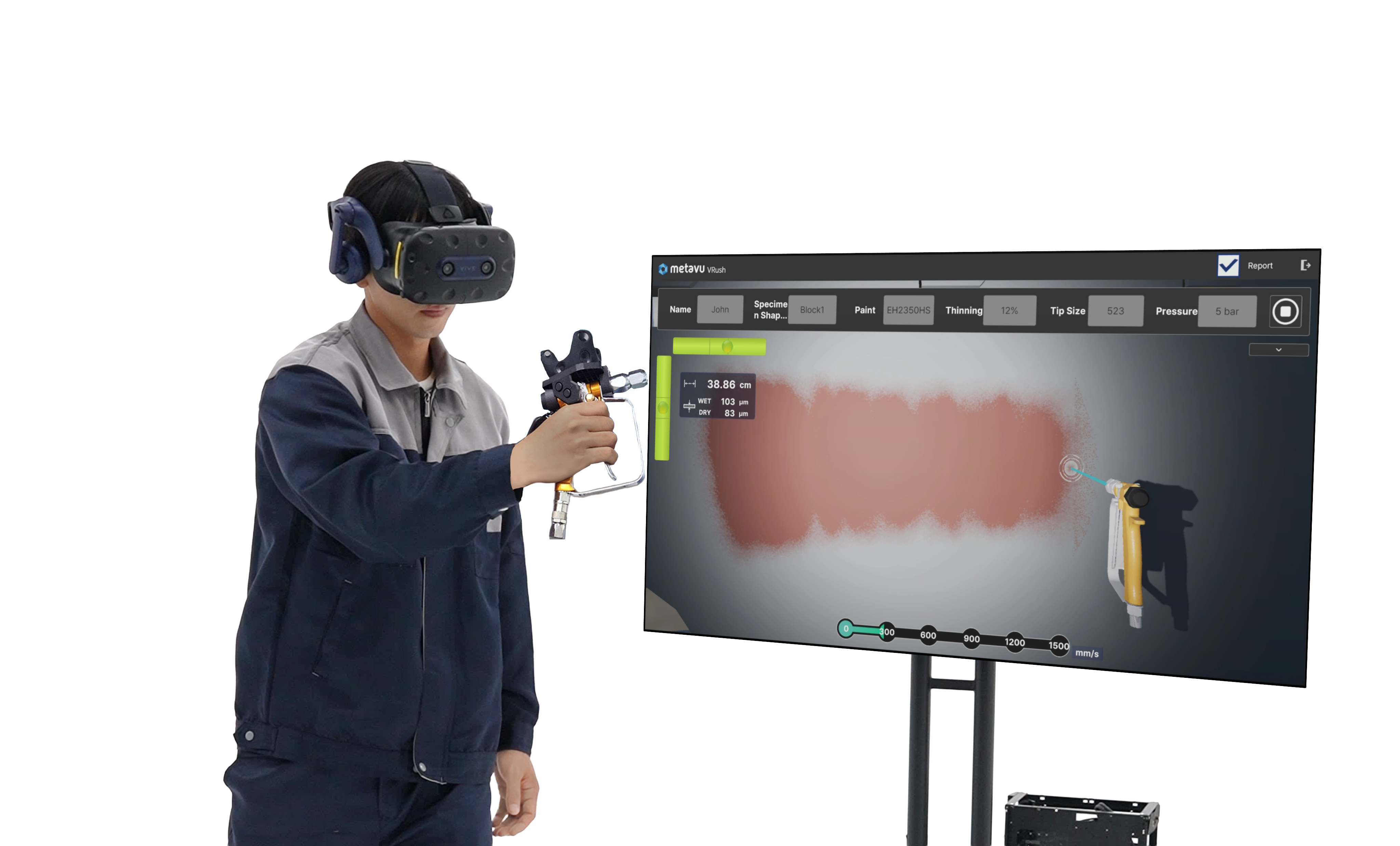
MetaVu-VRush is a high-precision industrial simulation platform
that accurately replicates real shipyard painting processes in a VR environment.
Key tasks such as coating thickness control, spray distance and angle maintenance,
painting in confined spaces, and quality deviation control are reproduced in detail.
With HDRP-based visual rendering and quantified data analysis,
the system enables objective evaluation of worker proficiency, safety, and consistent quality.
During the competition, participants performed painting tasks under identical conditions in VR,
where spray patterns, coating quality, and work posture were all quantified and evaluated.
Judges and spectators were able to monitor the process in real time via PC screens,
allowing for far more structured and effective feedback.
Training Time Reduced by 50%
A representative from Korea Shipbuilding & Offshore Engineering stated:
"Previously, it took about one year on average for workers to reach field readiness,
although it varied depending on individual skill levels.
After implementing the MetaVu-VRush system, this period was reduced by approximately six months."
This demonstrates the system’s value in addressing key industry challenges such as
securing skilled labor, reducing training gaps, lowering rework costs, and improving safety.
Toward a New Standard in Shipbuilding Education
Ship painting is classified as a high-risk, high-difficulty, and high-cost operation,
and quality variation directly impacts productivity and maintenance costs.
MetaVu-VRush serves as a digital training infrastructure that addresses these challenges,
and is gaining strong attention in the B2B market for its value in:
· Industrial VR safety training
· Simulation-based defect prevention
· Skill-based HRD digital transformation
· Data-driven quality evaluation and standardization
· ESG-aligned eco-friendly training systems
· Scalable global training standards for shipyards
This case clearly shows that MetaVu-VRush goes beyond experiential XR content,
positioning itself as a practical tool for skill validation and training quality improvement in real industrial environments.
Moving forward, MetaVu-VRush is expected to expand beyond shipbuilding
into broader industrial sectors, supporting high-risk process training, smart work environments, and productivity optimization.



#MetaVuVRush #ShipPaintingVR #ShipbuildingXR #IndustrialVREducation #DigitalTraining #SmartShipyard #HDHyundai #SkillsCompetition #SafetyTraining #XRTraining #QualityControl #IndustrialSimulation #B2BTech #SmartWork #HRDDigital #ESGTraining #HighRiskTraining #SpraySimulation #CoatingControl #ShipbuildingInnovation